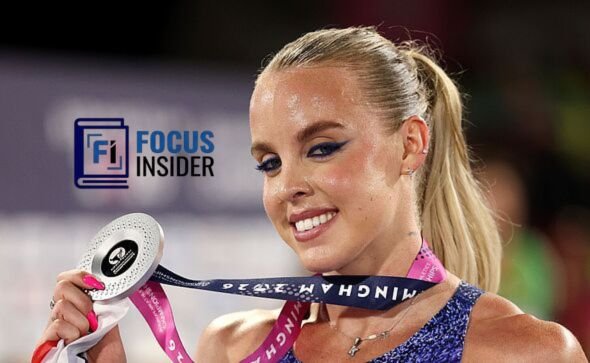
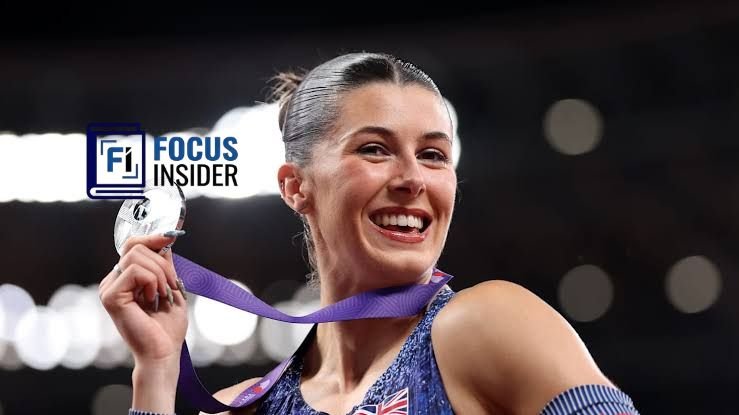
Amy Hunt Age Career Records and Rise of the British Sprint Star
Amy Hunt is a British sprinter who has developed from a record-breaking teenage prospect into one of Britain’s leading 100m and 200m athletes. Born on 15 May 2002, Hunt is 24 years old as of September 2026. Her career includes an Olympic relay silver medal, an individual World Championships silver medal and multiple European titles.
What makes Hunt’s story particularly interesting is that her progress has not followed a perfectly smooth path. She became internationally known as a teenager, combined elite athletics with studying English at the University of Cambridge, dealt with a significant injury and then returned to establish herself at senior international level. By 2026, her performances over both 100m and 200m had placed her among the world’s leading sprinters.
Quick Bio
| Amy Hunt – Personal Information | Details |
|---|---|
| Full Name | Amy Hunt |
| Date of Birth | 15 May 2002 |
| Age | 24 years (as of September 2026) |
| Birthplace | Grantham, England |
| Nationality | British |
| Profession | Professional sprinter |
| Amy Hunt – Career Information | Details |
|---|---|
| Sport | Athletics / Track and Field |
| Main Events | 100m, 200m, 4×100m relay |
| 100m Personal Best | 10.97 seconds |
| 200m Personal Best | 22.08 seconds |
| Education | English, Corpus Christi College, University of Cambridge |
| Major Achievement | Olympic relay silver medallist; World Championships 200m silver medallist |
Who Is Amy Hunt?
Amy Hunt is a British track-and-field athlete specialising primarily in the 100 metres, 200 metres and 4x100m relay. British Athletics lists all three among her events.
She was born in Nottinghamshire and grew up around Grantham. Team England lists her birthplace as Grantham, while other profiles describe her Nottinghamshire background. Her ability became clear at a young age, but her breakthrough in 2019 transformed her from a promising junior into an internationally recognised sprint prospect.
Her career is also unusual because education remained an important part of her life while she pursued elite sport. Hunt studied English at Corpus Christi College, University of Cambridge, graduating before fully establishing herself among the senior sprint elite.
Amy Hunt’s Breakthrough and Under-18 Record
The performance that first put Amy Hunt firmly on the athletics map came in Mannheim, Germany, in June 2019.
Still only 17, Hunt ran the 200m in 22.42 seconds. BBC Sport reported that it was a world under-18 record and also improved Dina Asher-Smith’s British under-20 record. Remarkably, it came in only Hunt’s fifth competitive outdoor 200m race.
That performance immediately changed expectations around the young athlete.
Later in 2019, she won European Under-20 titles in both the 200m and 4x100m relay, confirming that her breakthrough was more than a single exceptional race.
The early success brought attention, but it also created enormous expectations. Hunt’s later career would demonstrate that junior brilliance does not automatically translate into a straightforward journey through senior athletics.
Education at Cambridge
One of the most distinctive parts of Amy Hunt’s biography is her commitment to education.
Hunt attended Cambridge University, where she studied English at Corpus Christi College. Combining university work with elite sprint training required her to manage two demanding environments simultaneously.
Her academic interests have remained an important part of her public identity rather than simply becoming a footnote to her athletics career.
Hunt has also spoken about helping other young women considering Cambridge while pursuing athletics. Team GB reported in 2026 that she had already helped several girls with the process and was interested in eventually creating a more formal scholarship initiative connected with athletics.
That combination of academic ambition and elite sport became especially visible following her breakthrough individual medal at the World Championships.
Injury and the Difficult Road Back
Hunt’s rise was interrupted by circumstances that made the transition from junior to senior competition much harder.
The Covid-19 pandemic disrupted athletics calendars and university life, while Hunt also suffered a serious tendon injury. Team England notes that she ruptured a tendon, requiring surgery and extensive rehabilitation.
For an athlete whose reputation had been built around exceptional speed at a young age, a lengthy interruption could easily have changed the direction of her career.
Instead, Hunt gradually rebuilt herself.
Her eventual return to major international success is important when looking at her overall career. The years between her spectacular junior breakthrough and her senior medals show why athletic development cannot always be judged by a simple year-by-year progression.
Paris 2024 Olympic Silver
The Paris 2024 Olympic Games became a major milestone in Hunt’s senior career.
Hunt was part of Great Britain’s women’s 4x100m relay programme, helping Britain secure an Olympic silver medal. World Athletics lists her as an Olympic Games silver medallist.
The relay success represented an important transition.
Hunt was no longer simply the teenager remembered for an extraordinary junior record. She was now an Olympic medallist competing successfully on one of athletics’ biggest stages.
The British relay squad also recorded 41.55 seconds in London on 20 July 2024, a mark listed by World Athletics as equalling the national record at that time.
World Championships Breakthrough in 2025
Hunt reached another level individually at the 2025 World Athletics Championships in Tokyo.
She won the silver medal in the women’s 200m, giving her a first individual senior global championship medal. Team England describes the result as a major coming-of-age moment in her career.
Her performance was significant because it demonstrated that Hunt could translate her talent into individual success at global senior level.
World Athletics records her 200m personal best as 22.08 seconds, achieved on 18 September 2025.
That performance helped establish the 200m as one of Hunt’s strongest events while she continued developing her shorter sprint speed.
Amy Hunt’s 2026 Season
The 2026 season added another major chapter to Hunt’s career.
Her improvement was particularly noticeable over 100m. World Athletics lists a personal best of 10.97 seconds, recorded on 7 June 2026. She also ran 7.04 seconds over 60m indoors in February 2026.
Breaking 11 seconds in the 100m represented a significant milestone. Team England notes that Hunt became only the fourth British woman to achieve the feat.
The performances showed that she was becoming more than a 200m specialist. Her ability across 60m, 100m and 200m made her increasingly versatile within elite sprinting.
European Championships Success
Hunt produced one of the defining performances of her career at the 2026 European Athletics Championships in Birmingham.
She won an extraordinary four gold medals, becoming the first athlete to achieve that feat at a single edition of the European Athletics Championships, according to contemporary reporting.
The championship turned Hunt from an established elite athlete into one of the most prominent names in British track and field.
Her European success also strengthened a medal collection that already included Olympic and World Championship silver medals.
Amy Hunt Personal Bests
According to World Athletics, Hunt’s major personal bests as of September 2026 include:
- 100m: 10.97 seconds — 7 June 2026
- 200m: 22.08 seconds — 18 September 2025
- 60m indoor: 7.04 seconds — 22 February 2026
- 50m indoor: 6.20 seconds — 3 February 2026
World Athletics ranked Hunt No. 4 in the women’s 200m and No. 6 in the women’s 100m when its profile was accessed in September 2026. Rankings change throughout a season, so these positions should be treated as a current snapshot rather than permanent career rankings.
What Makes Amy Hunt’s Running Style Effective?
Elite sprinting depends on much more than maximum speed.
The 100m requires explosive acceleration and the ability to maintain velocity through a relatively short race. The 200m adds the technical challenge of running the bend efficiently while preserving enough speed for the home straight.
Hunt’s results across both distances demonstrate her range.
Her improvement below 11 seconds in the 100m suggests increased raw speed, while her 22.08-second 200m performance shows that she can carry high velocity over the longer sprint.
Her indoor performances provide another useful indication of acceleration. A 7.04-second 60m personal best places considerable emphasis on the start and early phases of sprinting.

Amy Hunt Beyond Athletics
Hunt’s public profile has expanded alongside her performances.
Her combination of elite athletics and academic achievement has become an important part of how she presents herself. She has discussed helping younger athletes pursue university opportunities rather than feeling forced to choose immediately between education and high-level sport.
She has also become increasingly comfortable discussing the representation of female athletes and the expectations placed on women in professional sport.
That broader visibility means Hunt’s influence now extends beyond race results. Nevertheless, her athletics performances remain the foundation of her growing profile.
How Amy Hunt Fits Into British Sprinting
Great Britain has produced several internationally successful female sprinters, including Dina Asher-Smith, whose British junior record Hunt surpassed during her spectacular 2019 breakthrough.
Hunt belongs to a newer generation seeking to continue that tradition.
Her career already covers several distinct stages: junior record-holder, university student-athlete, injured athlete rebuilding her career, Olympic relay medallist, world individual medallist and European champion.
That progression is particularly useful for understanding why her reputation cannot be based solely on the remarkable 22.42 she ran as a teenager.
The stronger measure of her development is what happened afterward: she eventually became faster at senior level, running 22.08 for 200m and 10.97 for 100m while collecting medals at major championships.
What Could Come Next for Amy Hunt?
At 24 in September 2026, Hunt remains at an age where further development is possible, although future performances cannot be predicted with certainty.
Her recent results show that she is internationally competitive in both major individual sprint distances. That gives her several potential championship options, alongside Britain’s traditionally strong relay programme.
Hunt has also discussed longer-term ambitions within athletics. In a 2026 interview, she spoke about potentially exploring the 400m later in her career, citing the versatility of athletes such as Allyson Felix.
For now, however, her established international results are concentrated in the 100m, 200m and sprint relays.
Conclusion
Amy Hunt’s career has developed far beyond the spectacular junior performance that first introduced her to the athletics world in 2019. She has successfully moved from record-breaking teenager to Olympic medallist, World Championships silver medallist and multiple European champion.
Her story also stands out because of the route she took to the top. Hunt combined Cambridge studies with elite training, recovered from a serious tendon injury and continued developing until she became faster as a senior athlete than she had been during her celebrated junior years. With personal bests of 10.97 seconds for 100m and 22.08 for 200m, Hunt entered the latter part of 2026 as one of Britain’s leading female sprinters.